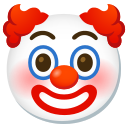
🤡 is a clown face: white face paint, red nose, colourful hair. It arrived with Unicode 9.0 in 2016 and was meant for circuses, birthday parties and Halloween costumes. These days it is far more likely to appear under a failed prediction or after a humiliating misjudgement, where it means “I played myself” or “you’re being ridiculous.”
How it’s used
- Self-roast: “Texted my ex ‘happy birthday’ and got left on read 🤡”
- Admitting a bad call: “I said this team would win by ten. Clown behaviour 🤡”
- Sarcasm: a lone 🤡 under a confident post that later turned out wrong
- Literally: a kid’s party entertainer, circus night, a Halloween costume, a horror film like *It*
The pattern behind most uses is “I was the only one who took this seriously.” It has more sting than 😅 (grinning with sweat), because the joke is on the sender.
Korea, Japan and the English-speaking world
In English, “you’re a clown” is already an insult, and the “putting on the clown makeup” meme turned 🤡 into a standard way of mocking your own wishful thinking. You will see it in sports threads, dating talk and finance memes. It has also been picked up in some political meme culture, so a 🤡 aimed at a stranger can read as pointed or hostile.
In Korean, 광대 (“clown”) and 삐에로 already describe someone who ends up looking foolish while trying to entertain, so 🤡 lines up naturally. It shows up in community comments and group chats, usually as self-deprecation about a one-sided effort. Aimed directly at another person, it is a strong jab.
In Japan the clown is ピエロ, and phrases like ピエロを演じる (“play the fool”) exist, but turning 🤡 into a self-mocking or insulting emoji is not a settled habit. It is still associated with circuses, events and Halloween in a mostly neutral way.
Where it gets misread
- Calling a friend 🤡 is a joke between close friends and an insult everywhere else. Keep it for yourself unless you know the person well.
- The cheerful children’s-party clown and the internet’s mocking clown are the same picture. In a work email it can look sarcastic by accident.
- It is not a villain emoji like 😈 or 👹. Horror films give clowns a scary reputation, but the emoji itself leans silly, not sinister.
- It is not 🤪 (zany face), which is playful on purpose. 🤡 carries the idea that you are the one who got fooled or made a mistake.
Design differences by platform
The core elements are shared across platforms: white paint, red nose, bright hair. Apple’s version tends to be crisp and vivid, Google’s Noto is rounder and simpler, Microsoft’s Fluent looks dimensional and playful, and Samsung usually draws a large, clear grin. Hair colour and make-up details differ slightly from platform to platform, so the same 🤡 can feel friendlier or more biting to the person on the receiving end.