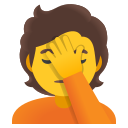
🤦 is a person covering part of the face with one hand pressed against the forehead. The gesture lived as the internet “facepalm” meme for years, meaning “this is so dumb I have no words,” before it became an emoji in 2016. The base form is a person of unspecified gender; 🤦♀️ (woman) and 🤦♂️ (man) and skin-tone variants are available. Most people just call it “the facepalm emoji.”
How it’s used
- Self-blame: “Got home and realized I left my umbrella at the café 🤦”
- Disbelief at someone else: “She forgot her password again 🤦♀️”
- Predictable outcomes: “Ordered pizza again, obviously 🤦♂️”
- Sighing at the news: “This is the official statement? 🤦”
- A gentle “you didn’t know?”: “That was announced yesterday 🤦”
Where 🙄 (face with rolling eyes) is irritated dismissal, 🤦 is “this is so embarrassing I can’t look.” Where 🤷 (person shrugging) deflects responsibility with “no idea, not my problem,” 🤦 contains a verdict: somebody, often the sender, clearly messed up. Compared with 😩 (weary face), it is more about absurdity than suffering.
Korea, Japan and the English-speaking world
In English, “facepalm” is so established that it works as a verb, and the gesture was a meme long before the emoji thanks to the shot of Captain Picard from Star Trek pressing a hand to his forehead. 🤦 is understood as that meme compressed into one character, and it is everywhere in replies to political news and ridiculous statements. English speakers use the gendered forms 🤦♂️ and 🤦♀️ more often than Koreans do, and self-directed use (“🤦♂️ why did I say that”) is just as common as mocking others.
In Korea it stands in for the sighs 아이고 (“oh dear”) and 내가 미쳤지 (“I must have been crazy”). Attached to a confession of a small mistake, it signals “I already know this was dumb,” which makes it harder for the other person to pile on. The woman variant 🤦♀️ seems more common there, and the emoji turns up constantly under political and social news in online communities. Pointed at someone else’s mistake, though, it delivers a judgment of “that was pathetic,” so it reads as aggressive outside close friendships.
In Japan the official name is ひたいに手をあてる人 (“person with hand on forehead”), but it is felt as やれやれ (“good grief”) or 顔を覆う (“covering one’s face”). The English facepalm meme was never imported wholesale, so the main use is a modest display of one’s own blunder. Using it at someone else is considered fairly strong even in Japan, and people often soften it with 😅 unless they are close.
Where it gets misread
- A bare 🤦 in response to someone’s mistake says “you are hopeless.” Avoid it in work settings or with anyone senior to you, whatever you mean by it.
- 🤦 and 🤷 look alike at small sizes because both involve a raised hand. In 🤦 the hand is on the face; in 🤷 the hands are at shoulder height. The meanings, “this is dumb” versus “no idea,” are opposites in attitude.
- The base 🤦 can look male on one platform and female on another. If gender matters in context, use 🤦♂️ or 🤦♀️ explicitly.
- It is not a headache. If your head actually hurts, 🤕 (face with head-bandage) or plain words will land better.
Design differences by platform
Apple shows a fairly realistic upper body with the palm flat on the forehead and eyes closed, so it reads as a deep sigh; the base version has short, androgynous hair. Google’s Noto simplifies the head and hand into something closer to an icon with a calmer expression. Microsoft’s Fluent version is three-dimensional with a large hand that clearly cups the face, and Samsung turns the figure slightly sideways, which adds a hint of looking away. Hair style and shirt color of the base form differ by platform, so the same 🤦 may appear as a different gender on the recipient’s phone.