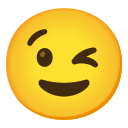
😉 winks with one eye while the mouth curves into a small smile. It is the pictorial heir of the text emoticons ;) and ;-), and it entered Unicode in 2010. A wink is a gesture of shared secrets, and the emoji keeps that role: it signals that the sentence has an extra layer, a joke, a hint or a private understanding. That makes it one of the most flexible faces, and one of the most context-dependent.
How it’s used
- Marking a joke: “I did say I’d pay, didn’t I? Kidding 😉”
- A secret: “Our little secret 😉”
- Encouragement: “You’ve got this 😉”
- Light teasing: “I know exactly what you did 😉”
- A friendly sign-off: “See you tomorrow, don’t be late 😉”
😜 (winking face with tongue) takes the wink in a sillier direction, and 😘 sends a kiss outright. 😏 (smirking face) turns up one corner of the mouth for a knowing, smug look, which makes it more suggestive than 😉.
Korea, Japan and the English-speaking world
In English, 😉 is the standard wink, and the one most people picture when they think of the emoji. It covers teasing, light flirtation and ironic jokes. The old phrase “wink wink, nudge nudge” from British comedy shows how long the gesture has been tied to winking at what goes unsaid.
In Korea, winking is rare in daily life, so 😉 tends to land as either a cute joke or a slightly forward move. Between couples and close friends it works as playful charm, but in a workplace or with someone you barely know, it can be awkward. Fans also associate it with idols winking at the camera on stage.
In Japan the name is ウインク, and the emoji descends from kaomoji such as (^_-)-☆. It suits a cheerful, teasing, お茶目 (impish) voice. People don’t use it much in daily chat, but it is familiar from idols’ and characters’ winking poses.
Where it gets misread
- Sent to a coworker or someone you’ve just met, 😉 is likely to be read as flirting. If the other person is uncomfortable, that reading wins.
- Adding “just kidding 😉” does not erase a hurtful remark; the wink doesn’t cancel the content.
- Combining it with 😜, 😘 and 😏 raises the temperature quickly. Stop at one if you only mean playfulness.
- After a serious promise or an apology, it can seem like you’re not taking it seriously.
Design differences by platform
All four vendors give a yellow face with one closed eye and a lifted mouth. The curve of the closed eye, the brows and the mouth change the character. Apple’s closed eye has a soft curve that feels friendly; Google’s Noto is simple and plain. Microsoft’s Fluent has a dimensional style that looks a bit more sly, and Samsung is broadly similar though the coloring is slightly different.